Tuesday, June 21, 2011

Thursday, June 16, 2011
Monday, June 6, 2011
Don't like that tone?
http://blisstree.com/live/tonecheck-beta-now-you-can-censor-emotion-in-your-emails/
It has been a long standing problem that we do not always come off our best in non face-to-face contact
It has been a long standing problem that we do not always come off our best in non face-to-face contact
Smile Booth
We have arrived at our final concept for our Happiness Machine, we are going to focus on the the ability to pass emotions between individuals, this is known as emotional contagion and is believed to be a subconscious reaction with humans in social situations.
To address this subject we are going to build an interactive installation that will use smile detection to detect when two users syncronise facial expressions and reward the users in some way. Our aim in this is to create smiles, after the considerations from our smile experiment I did some further research into smiling on demand, from this I learned that there is a growing body of research that suggests that a facial expression can occur before the emotion with which it is associated. Based on this research we aim to make participants smile (either real or on cue) with the knowledge that this can in fact trigger happiness.
To address this subject we are going to build an interactive installation that will use smile detection to detect when two users syncronise facial expressions and reward the users in some way. Our aim in this is to create smiles, after the considerations from our smile experiment I did some further research into smiling on demand, from this I learned that there is a growing body of research that suggests that a facial expression can occur before the emotion with which it is associated. Based on this research we aim to make participants smile (either real or on cue) with the knowledge that this can in fact trigger happiness.
Tuesday, May 10, 2011
Japanese Smile Detector Evaluates Smiles, Makes It Better
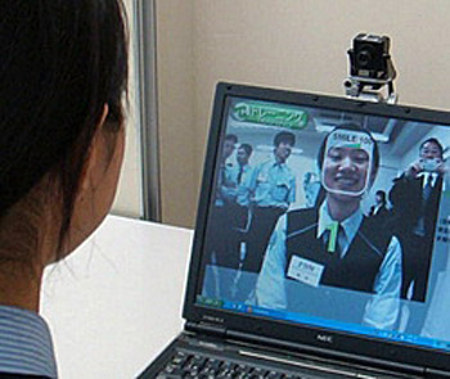
Customer service employees, for the most part, are doomed to spending their hours wearing fake smiles and cheerful faces. In Japan's Keihin Electric Express Railway, it gets worse: they make sure that the pretend geniality is as close to authentic as can be with "smile-checking" software.
Part of the morning routine for Keihin employees is to take a picture with the biggest smile they can muster. The photo is then picked up and processed by the company's evaluation app, which compares each part of the service worker's face with the ideal characteristics of a "high-quality smile".
Grades are given for each part of the face, including eye movements, lip curves, cheek position and facial lines. The numbers are added up and rated on a scale of one to 100. Less-spirited grunts with low scores are instructed to keep adjusting their "smiling faces" until the software assigns them a passing score. Once they pass, they are given a copy of their "winning smile" so they can try replicating it throughout the day.
Can you imagine how a session like this might be like? "Your eyes are too wide when you smile. It looks fake. The software suggests to attempt squinting a little." That's a scene in a comedy film waiting to happen.
Seriously, though, I'd love to see the same software used across all customer service companies. Is it a pain in the ass for employees? I'm pretty sure it is. Imagine how good your day will be, though, if everyone you dealt with in the service industry had a shit-eating grin permanently plastered on their mug?
[via iO9]
Mood Monitors

Today, every employee at TCL who has a workstation assigned to him/her has a Mood monitor. This initiative has received a phenomenal response across TCL with not just employees, but also visitors to our offices who request Mood monitors to carry back home.
The online Mood monitor, or K-monitor (Knowledge monitor) as it is also known, is a programme that displays a new question on the computer screen as soon a user logs onto the network every morning. Topics range from issues of organisational significance, opinion polls on organisational initiatives and information on various aspects of the organisation, to questions on general awareness, news, current affairs, history and the environment.
Responses received from around 1,000 employees daily are then analysed, and an e-mail with the results of the Mood monitor along with the correct response and relevant informative feedback is sent to all employees.
Employees are also invited to contribute questions to the Mood monitor. Creating awareness about key themes like our CoC, SHE, VMV, community initiatives, products and services, the Tata group etc, this initiative will soon complete 100 questions since the time it was launched.
The CheerRing is a brass bell called that has been hung at TCL offices in Mumbai, Noida, Ahmedabad and Pune. Any employee wanting to announce any positive, good and happy news about a personal, team or company achievement, birthday and fun announcements etc, needs to ring the bell. As we at TCL like to put it, the bell chimes for good times! A direct outcome of this initiative is a surge in energy, excitement and positivity in the office.
TCL also celebrates Diwali, the New Year, birthdays celebrations with a palpable gusto, making the organisation a truly vibrant and exciting place to work in.
Tuesday, April 12, 2011

Sunday, April 10, 2011
Smile High Score

These are the photos from our 'high-score' experiment, they are ordered from biggest to smallest smiles (as decided by our smile detector).
This experiment was actually a great success... We managed to fuel competition through word of mouth and Facebook and had many repeat visits as new high scores were set. We also had a lot of people asking us what the smile detector was actually looking for, unsure on whether we should answer this we experimented with the answers we gave.
One conversation that I had was particularly insightful to me. We discussed whether this big smile was 'better' as he asserted that it was fake and consequently not better; although he was not rewarded by the machine for his smaller natural smile he refused to put on a larger smile for its benefit. This got me thinking once again about fake smiles...
I am particularly interested with how fake smiles affect us and others, and if they are more useful or harmful.
Incentives


This has got me thinking about incentives and the way that we are convinced into thinking that doing something is a good idea. For instance 'high score' boards and 'employee of the month' competitions... Competition is an easy way to get people to engage with what what you would like them to.
Considering this I have decided that we are going to hold a smiling competition as our next studio experiment; getting people to compete on who can pull the biggest smile.
Will the winner be the happiest person? Will this sustained smiling make them happy? If you rank the smiles 'high-score' style, will those that do not make the leader board be less happy as a result?
These are some things that I would like to see how others respond to.
Grand Mutual Smiles

This installation is quite a simple idea but I like what it seeks to achieve, it recognises the smile as a form of universal communication and something that can be traded like a commodity.
Monday, March 28, 2011

The MIT Mood Meter is designed to assess the mood at key points around the MIT campus, smiles are used as a barometer for happiness and is used to "raise awareness of how our own smiles can positively affect the surrounding environment".
Real-time information is produced and can be used to help answer questions about the mood of students on Campus and is viewable on the project web site MIT Mood Meter.
I really like this concept as it is casting votes through mood and seems to be a very real way to analyse and improve factors around campus that may be preventing good moods.
Happiness Machine from Leo Koppel on Vimeo.
This cartoon reminds me of a poem I studied in high school:
Solitude (Ella Wheeler Wilcox)
Laugh, and the world laughs with you;
Weep, and you weep alone.
For the sad old earth must borrow it's mirth,
But has trouble enough of its own.
Sing, and the hills will answer;
Sigh, it is lost on the air.
The echoes bound to a joyful sound,
But shrink from voicing care.
Rejoice, and men will seek you;
Grieve, and they turn and go.
They want full measure of all your pleasure,
But they do not need your woe.
Be glad, and your friends are many;
Be sad, and you lose them all.
There are none to decline your nectared wine,
But alone you must drink life's gall.
Feast, and your halls are crowded;
Fast, and the world goes by.
Succeed and give, and it helps you live,
But no man can help you die.
There is room in the halls of pleasure
For a long and lordly train,
But one by one we must all file on
Through the narrow aisles of pain
In essence both of these works deal with the fact that you are only appealing to others while you are happy (because it is a thing of worth)!!!
I think the idea that a smile has value and worth is very interesting as that would classify it as a commodity with very little stretching of the imagination; this would mean that a smile is trade-able and is in sort some form of currency that is necessary to get the things we want out of life.
Women smiling...
When I first talked about my smiling experiment with others I had a lot of curiosity in the response I received. One factor that seemed to come up in these discussions was gender, and how as a female smiling indiscriminately at people I passed, for it to be seen as a sexual advance.The number of applications for a smile are vast and I hadn't considered this to be the case except for one factor, the sustained eye contact until the withdrawal of the other person. This is overt behaviour and I can see the potential for someone to think there is intention beyond this type of contact.
It was pointed out to me that while acceptable in this country my behaviour would not be tolerated everywhere in the world. I found while researching that it is a major Islamic sin (Al-Kaba'ir) for a women to smile at 'strange men' and it is highly punishable in the afterlife! The following is a 'Hadith about Women'... found here
" I am recalling a moment when I went for me'raj and I ascended the heavens, on that particular night I found six categories of the women of my ummat being subjected to such form of torment that every time I think about that azaab it makes me cry, he then started to explain...
I saw a women hung by her hair suspended in the depth of jahannam, her brains were boiling. Then I saw a women hung by her tongue, and the water of jahannam was being poured down her throat. Then I saw a women hung by the upper portion of her chest. Then I saw a women, her legs were tied to her chest and her hands were tied to her forehead. Then I saw one women, she was disfigured, she had the head of a swine and the body of a donkey, snakes were surrounding her. Then I saw a women in the form of a dog, and the angels were striking her.
What were the crimes of these women that they were subjected to such forms of azaab?
With regards to the woman who was hung by her hair, she walked outside freely, exposing and revealing her hair to strange men. The one who was hung by her tongue, she used to verbally abuse her husband. The woman who was hung by the upper portion of her chest, she was an immoral women, an unchaste women smiling with strange men. The woman whose legs were tied to her chest and her hands tied to her forehead, this women was very negligent with the aspects of purity, when it came to the period after her menstrual cycle, she had to purify herself so she could pray her salaah. And with regards to that woman who was disfigured, she was one who carried tales and used to lie openly. Finally the woman who was in the form of a dog, she was one who constantly reminded others about her favours and her heart is full of jealousy."
This view is so different from the climate that we live in really shows how differently things can be interpreted in different contexts and/ or cultures... I think that the application of smiles definately has the scope to be explored/ exploited in my Happiness Machine project.
This view is so different from the climate that we live in really shows how differently things can be interpreted in different contexts and/ or cultures... I think that the application of smiles definately has the scope to be explored/ exploited in my Happiness Machine project.
Tuesday, March 22, 2011
Cheese
This video installation entitled 'Cheese' is a "experiment in the architecture of sincerity". Female actresses are asked to smile at a camera for an hour and a half, having their expressions constantly analysed for sincerity... If the actress does not display a large enough smile to satisfy the software an alarm begins to sound, and will continue to sound until a satisfactory smile is once again plastered across her face.
This work deals with forced friendliness and the 'work' that appearing happy at all times involves.
I like the subject matter of this piece as we can all relate to being expected at times to appear friendly when we are feeling the exact opposite... It also seems that by using all female actresses Moeller is suggesting that females with their often empathetic nature are easily exploited into appearing happy for the sake of others. The installation is quite blatant and after watching the women for only a short time we can see the discomfort that they are in while trying to conform to their instructions.
I do not however like the gallery setup that shows all this footage simultaneously... it is overwhelming and makes it easier to miss the all the emotional signifiers that are occurring on the women's faces.
I think that this work is very strong and deals with happiness from a unique perspective, that the appearance of happiness is sometimes false and for the benefit of others...Ultimately that it may be more detrimental than good!
Monday, March 21, 2011
Can we spot fake smiles???
I found an interesting quizz that tested the users ability to distinguish between real and fake smiles on the BBC Website.
I scored a 17/20 on deciding if a smile was genuine or fake from short video clips played once only.
"Most people are surprisingly bad at spotting fake smiles. One possible explanation for this is that it may be easier for people to get along if they don't always know what others are really feeling.
Although fake smiles often look very similar to genuine smiles, they are actually slightly different, because they are brought about by different muscles, which are controlled by different parts of the brain.
Fake smiles can be performed at will, because the brain signals that create them come from the conscious part of the brain and prompt the zygomaticus major muscles in the cheeks to contract. These are the muscles that pull the corners of the mouth outwards.
Genuine smiles, on the other hand, are generated by the unconscious brain, so are automatic. When people feel pleasure, signals pass through the part of the brain that processes emotion. As well as making the mouth muscles move, the muscles that raise the cheeks – the orbicularis oculi and the pars orbitalis – also contract, making the eyes crease up, and the eyebrows dip slightly.
Lines around the eyes do sometimes appear in intense fake smiles, and the cheeks may bunch up, making it look as if the eyes are contracting and the smile is genuine. But there are a few key signs that distinguish these smiles from real ones. For example, when a smile is genuine, the eye cover fold - the fleshy part of the eye between the eyebrow and the eyelid - moves downwards and the end of the eyebrows dip slightly.
Scientists distinguish between genuine and fake smiles by using a coding system called the Facial Action Coding System (FACS), which was devised by Professor Paul Ekman of the University of California and Dr Wallace V. Friesen of the University of Kentucky." - bbc.co.uk
I found this very interesting and it has made me think about the difference between real and fake smiles and what the application for fake smiles might be...
Are fake smiles deceptive and therefore less valid than real smiles or are they just a useful tool to have in one's repertoire that will make someone else happy without you actually having to change your mood if you are not inclined to?
I scored a 17/20 on deciding if a smile was genuine or fake from short video clips played once only.
"Most people are surprisingly bad at spotting fake smiles. One possible explanation for this is that it may be easier for people to get along if they don't always know what others are really feeling.
Although fake smiles often look very similar to genuine smiles, they are actually slightly different, because they are brought about by different muscles, which are controlled by different parts of the brain.
Fake smiles can be performed at will, because the brain signals that create them come from the conscious part of the brain and prompt the zygomaticus major muscles in the cheeks to contract. These are the muscles that pull the corners of the mouth outwards.
Genuine smiles, on the other hand, are generated by the unconscious brain, so are automatic. When people feel pleasure, signals pass through the part of the brain that processes emotion. As well as making the mouth muscles move, the muscles that raise the cheeks – the orbicularis oculi and the pars orbitalis – also contract, making the eyes crease up, and the eyebrows dip slightly.
Lines around the eyes do sometimes appear in intense fake smiles, and the cheeks may bunch up, making it look as if the eyes are contracting and the smile is genuine. But there are a few key signs that distinguish these smiles from real ones. For example, when a smile is genuine, the eye cover fold - the fleshy part of the eye between the eyebrow and the eyelid - moves downwards and the end of the eyebrows dip slightly.
Scientists distinguish between genuine and fake smiles by using a coding system called the Facial Action Coding System (FACS), which was devised by Professor Paul Ekman of the University of California and Dr Wallace V. Friesen of the University of Kentucky." - bbc.co.uk
I found this very interesting and it has made me think about the difference between real and fake smiles and what the application for fake smiles might be...
Are fake smiles deceptive and therefore less valid than real smiles or are they just a useful tool to have in one's repertoire that will make someone else happy without you actually having to change your mood if you are not inclined to?
Smiles Experiment
I have had quite a bit of trouble starting the 'Happiness Machine' project... So I finally started with a simple social experiment. I spent one morning on the trip between my home and University (roughly one and a half hours) smiling at every person that I made eye contact with. This felt somewhere between normal and creepy for me, I am used to smiling at people but sustaining this is actually quite an exposing and personal experience...
There was an undeniable trend in the reactions from the individuals I engaged with a smile... Smiling and then instantly looking away.
This would suggest to me that smiling is a rather instinctual response, I had once heard that people are naturally quite empathetic and that expressions and emotions are often mirrored back at whom they originate from. This would explain the instinctual smile back and then upon recognising their lack to familiarity with me as an individual the aversion so they would not be obligated into making any further contact with me.
I guess that often when a stranger makes contact with you in this way they want something from you and this suspicion is therefore justified although I couldn't be sure that this is the common psyche.
There was an undeniable trend in the reactions from the individuals I engaged with a smile... Smiling and then instantly looking away.
This would suggest to me that smiling is a rather instinctual response, I had once heard that people are naturally quite empathetic and that expressions and emotions are often mirrored back at whom they originate from. This would explain the instinctual smile back and then upon recognising their lack to familiarity with me as an individual the aversion so they would not be obligated into making any further contact with me.
I guess that often when a stranger makes contact with you in this way they want something from you and this suspicion is therefore justified although I couldn't be sure that this is the common psyche.
Upgrade to Website
For the beginning project of the year all of the second year students have been instructed to upgrade to a portfolio website in semester 1. Therefore this blog is temporary and will later migrate to my very own website. In the meantime however it will be used to convey my project ideas and updates etc. to help me examine and refine my ideas
Subscribe to:
Posts (Atom)